Show printable version of 'Key Lake Road Project' item in a New Window
Email 'Key Lake Road Project' item to a friend


Introduction
The Key lake Road Project area consists of 5 projects, covers over 240,000 ha and 100 km of prospective mine trend. This location, the eastern margin of the Athabasca basin, is home to the most productive uranium mines in the world with roughly 25% of the worlds Uranium productions coming from this area. The projects are, Key Lake Road, Haultain River, Romulus, Orchid Lake, and Highrock Lake.

Geology
The Key Lake Road Project area covers favorable basement rocks within the Mudjatik-Wollaston Tectonic Zone, a northeast trending structural zone on the eastern margin of the Basin along which the district's most productive uranium mines occur. Over 95% of known Canadian uranium deposits and all current uranium producing mines in Canada are located on this trend.

The Mudjatik-Wollaston Tectonic Zone is the NE trending high strain tectonic zone marking the boundary between the Archean gneisses and granitoids of the Mudjatik Domain to the west and Archean gneisses, metasediments, and pegmatite intrusions of the Wollaston domain to the east. Uranium mineralization on the Key Lake Road Project generally occurs within a Proterozoic, graphite-bearing suite of metapelite, pelite, calc-silicate and arkosic metasediments found within this high strain zone.

The Key Lake Road Project area is targeting basement hosted, structurally and stratigraphically controlled uranium deposits such as Cameco's Millennium deposit (containing 47.2M lbs of U3O8 indicated and inferred) and the Eagle Point/Rabbit Lake deposit (containing 19.0M lbs of U3O8 proven and probable). These deposits generally contain structurally controlled veins, breccias and massive replacement-type mineralization.

Key Lake Road Project
  • 100% owned, consisting of 25 mineral claims covering 111,564 ha
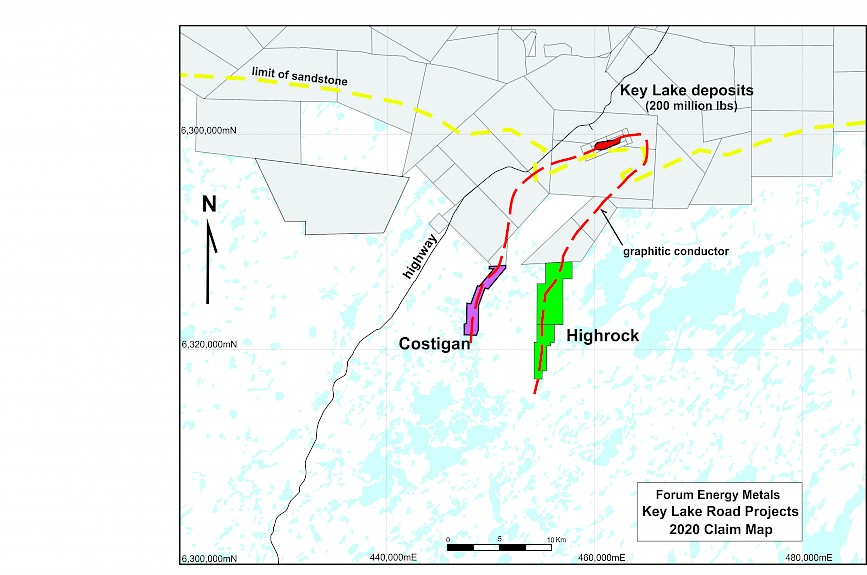
Forum's Key Lake Road project is located south of Cameco's Key Lake deposits, and 20 km southwest of Cameco's Key Lake Mine/Mill Complex, the principal processing facility for the nearby high grade McArthur River uranium mine and site of the formerly productive Key Lake Deposit. It is underlain by rocks that host all the known uranium deposits in the eastern Athabasca Basin, and also hosts a major shear zone. The project is almost 70km from north to south, and 12 to 20km wide.

Historical Work
Historical work completed by Forum Uranium and other companies on the Key Lake Road project including trenching, sampling, and geophysics, and drilling has outlined several key target areas such as the Millison, the DD, the Rainbow, the Molly, and the Hobo zones with grab samples in outcrop ranging from 0.032% to 7.65% U3O8.

Numerous uranium showings occur in the south end of the project, while the north end (nearest the Key Lake mine site) is covered by sand and has no outcrop. An airborne VTEM survey was carried out in 2005 along the shear zone and two main sub-parallel EM conductors, the C1 and C2, were outlined. Other shorter conductors to the east were also identified. Ground EM surveys precisely located these conductors, and this was followed by diamond drilling.

Drilling in the south part of the project in 2006 to 2008 (69 holes for 10,364m) identified numerous zones of structure and alteration (Molly, DD, Millison, Hobo), locally with weak uranium mineralization, with up to 0.1% U3O8 over 25cm (DD) and 0.154% U3O8 over 40cm (Hobo).

Highrock Lake
  • 100% Owned
The Highrock property is a continuation of the Black Forest part of the Key Lake project, hosting the Key lake deposits and the GAX, BV and P Patch showings (Figure 1). The conductive package that runs through the Highrock property is the southern extension of the same conductor that hosts the Key Lake deposits. This conductor is very strong and has a total length of 13.5km on the Highrock property, with the main conductive system running the entire 6 km length of the project.

To date, only 3 overburden holes have been drilled on the property in 1980. Forum is currently conducting a line-cutting program followed by ground EM and ground gravity to ready the project for a future drill program.

Costigan Lake Joint Venture
  • 743 ha (Forum is the operator, 65%, with NVI Mining (NVI), wholly owned subsidiary of Breakwater Resources Ltd ("Breakwater").
The Costigan Lake project is located 15 km southwest of the Key Lake deposit on what is interpreted to be the same graphitic horizon that hosts the deposits. The property consists of one mineral lease, ML 5487, with a total area of 743 ha and is owned by a joint venture partnership of Forum Uranium Corporation (65%) and NVI Mining Ltd. (35%). The Costigan Lake project was acquired in 2006 and an HLEM survey was completed over the entire property in the same year. This survey outlined four sub-parallel conductors through the entire length of the property.

Historical Work
A diamond drill program from consisting of 6 holes (824m) was completed by April of 2006, followed by another 2 holes in 2007 to test the conductors. Thick tectonized graphitic pelitic gneiss and weak uranium mineralization was encountered in drill holes COS-03 (0.069 % U3O8 over 0.1 m), COS-04 (0.026 % U3O8 over 0.2 m) and COS-05 (0.109 % U3O8 over 0.1 m) and in a historic hole CS 79-03 (0.088 % U3O8 over 4.02 m). Strong alteration was encountered in all four mineralized holes. Holes COS-07 and COS-08, drilled in 2007 encountered thick graphitic pelitic gneiss but no major structures or mineralization was intersected.

Romulus
  • 100% owned, consisting of 6,140 ha
The Romulus property was staked in 2007 and covers the northern extension of the Key Lake Road shear zone. Approximately 16 kilometres of conductor are on this property. Line-cutting, ground EM and ground gravity surveys are planned for this project to prepare it for future drill programs.

Maps
click to enlage
 
click to enlage
click to enlage
click to enlage
click to enlage