Show printable version of 'Henday Project' item in a New Window
Email 'Henday Project' item to a friend


Introduction
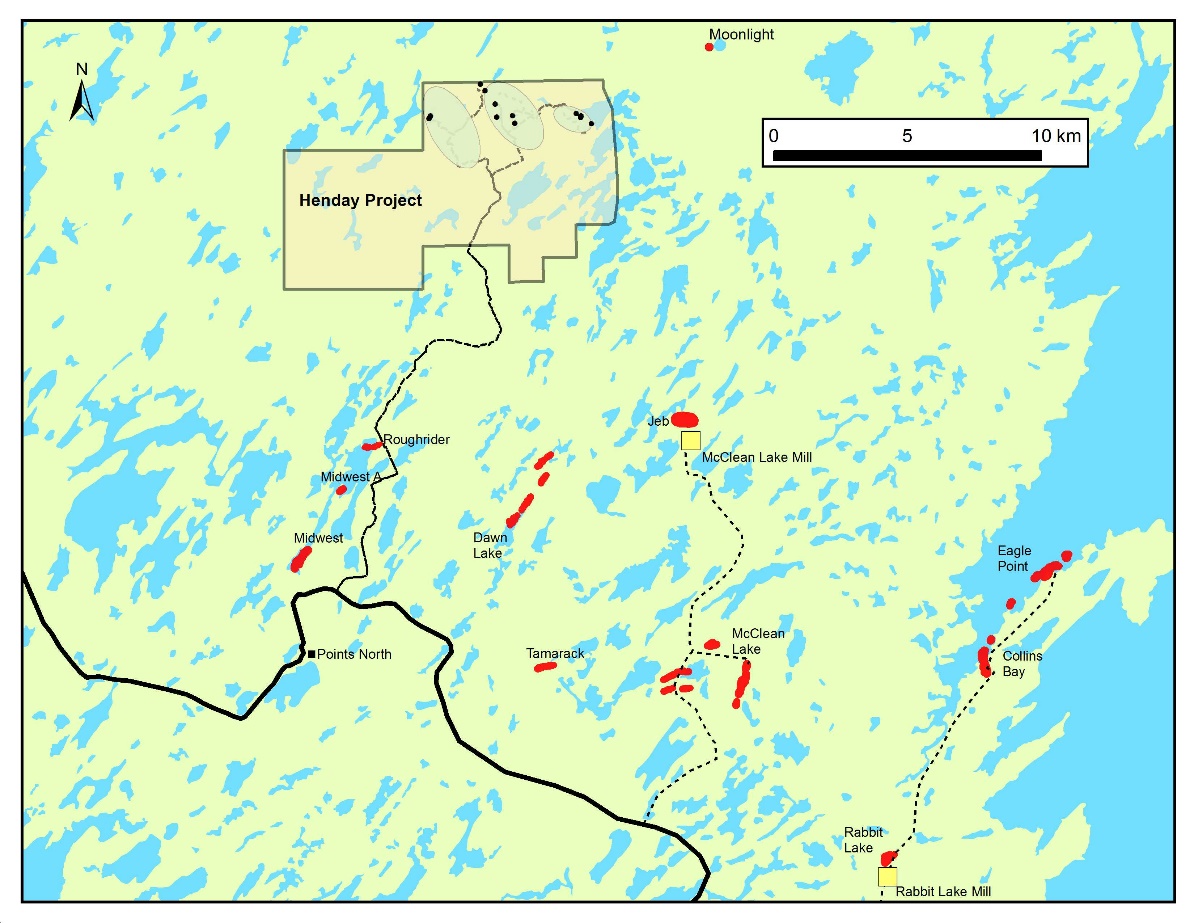
The 100%-owned Henday Project consists of 3 claims covering 7,204 ha of the north-eastern margin of the Athabasca Basin, Saskatchewan. The property is strategically located along the north-east trend which hosts the Midwest Lake mine project (41.0M lbs. U3O8 at an average grade of 5.5%) and the Midwest A Zone, where Denison Mines recently reported results of 10.5 meters grading 12.4% U3O8 to 22.6 meters grading 26.7% U3O8.

In 2009 Forum entered into an Option Agreement on the Henday project in the Athabasca Basin, Saskatchewan with Hathor Exploration Limited ("Hathor"). Hathor can earn up to a 60% interest in stages by spending $3.5 million in exploration over three years and making a payment of 150,000 shares upon TSX approval. Hathor's first year commitment is to complete a $500,000 ground electromagnetic and gravity survey program to commence immediately. A further 10% interest in the property can be earned by completing a feasibility study. Forum will be the operator up until Hathor completes its 60% interest. For the complete terms of the agreement please see news release dated February 27th/2009.


Geology
The Henday Project covers favorable basement rocks within the Mudjatik-Wollaston Tectonic Zone, a northeast trending structural zone on the eastern margin of the Basin along which the district's most productive uranium mines occur. Over 95% of known Canadian uranium deposits and all current uranium producing mines in Canada are located on this trend.

The Mudjatik-Wollaston Tectonic Zone is the NE trending high strain tectonic zone marking the boundary between the Archean gneisses and granitoids of the Mudjatik Domain to the west and Archean gneisses, metasediments, and pegmatite intrusions of the Wollaston domain to the east. Uranium mineralization on the Henday Project generally occurs within a Proterozoic, graphite-bearing suite of metapelite, pelite, calc-silicate and arkosic metasediments found within this high strain zone.

The Henday Project is targeting basement hosted, structurally and stratigraphically controlled uranium deposits such as Comeco's Millennium deposit (containing 47.2M lbs of U3O8 indicated and inferred) and the Eagle Point/Rabbit Lake deposit (containing 19.0M lbs of U3O8 proven and probable). These deposits generally contain structurally controlled veins, breccias and massive replacement-type mineralization. The mineralization on the Henday Property is shallow - the unconformity is at an average depth of 160 m, ranging from 125 m to 220 m.

Historical Work
Historical work on the Henday Project including mapping, trenching, sampling, drilling, and geophysics has outlined several mineralized zones including one drill intercept of 0.21% U3O8 over 4 m in the Athabasca sandstone at the unconformity, and 10 other holes have intersected anomalous uranium mineralization associated with electromagnetic conductive trends, strong clay alteration and anomalous geochemistry.

Previous ground electromagnetic surveys have outlined 8 conductive trends totaling 45 line kilometres on the property that identify prospective graphitic lithologies in basement rocks. Areva's Mallen lake showing lies to the south of the property where drill intercepts of 5.9% U3O8 over 0.3 m and 2.5% U3O8 over 0.3 m in basement rocks were encountered.

2010 Exploration Program

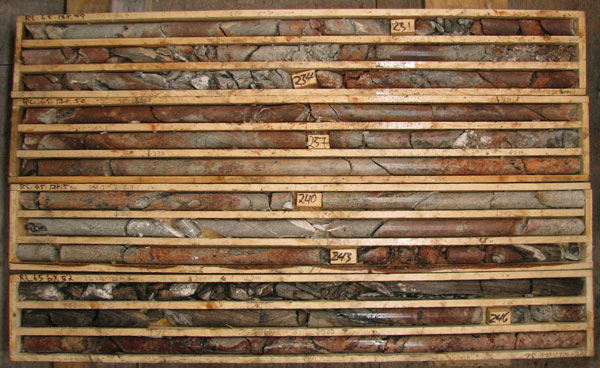
2010 drilling intersected a strong alteration halo in both the sandstone and well down into the basement with elevated geochemical indicators and weak uranium mineralization. The size and strength of the alteration encountered was positive, and extends over 200m in width and at least 200m in strike, being intersected by several graphitic conductors.

The alteration halo was encountered in 12 of the 18 holes drilled. A graphitic package within the alteration halo hosts the mineralization intersected to date. The uranium mineralization was very clean with almost no associated elements except for boron in one hole (1 metre of 0.162%), which is typical of basement-hosted uranium deposits in the Athabasca Basin. Geochemistry returned from core samples processed at the Saskatchewan Research Council show anomalous values of uranium in the basement lithologies. Highlights of the geochemistry include:


Hole #
Down-Hole Depth
(metres)
Thickness
Uranium (ppm)
Lbs U3O8 / ton
RL-66
135.4 - 137.9
2.5 m
264
0.5
RL-66
139.9 - 142.2
2.5 m
302
0.6
RL-66
144.0 - 144.5
0.5 m
491
1.0
RL-68
144.0 - 144.5
0.5 m
424
0.8
RL-68
221.2 - 221.7
0.5 m
1690
3.4


A resistivity survey was completed over the area of alteration in April. The survey shows a resistive low under Mallen Lake in the area of the alteration intersected by the winter drilling. This low is 200m by 200m at the level of the unconformity (110 metres). The resistivity survey showed that the main target area lies under the lake with approximately 700 metres of graphitic conductors within the resistivity low to be tested. A drill program proposed for the summer will be deferred until the winter drill season to adequately test the uranium mineralization and geophysical targets. Geochemical surveys will be run over several target areas throughout the summer to aid in focusing future drill programs.

2011 Exploration Plans

Drill Program Planned for 2011


Maps
click to enlarge
click to enlarge